
On this date (Aug 24)


On this date (Aug 24), in 2006, sentimental geeks the world over were heartbroken to discover that their favorite little ball of ice & rock was demoted.

For more than 76 years, Pluto enjoyed its status as the 9th planet in the Solar System. It was one of the big dogs – granted, it was by far the smallest, but it was in the cool kids’ club. There can only be one sun in our system, so the best chance for a hunk o’ rock to be in an exclusive clique was to be a planet!

After all, despite its small size, Pluto is pretty cool. It has 5 known moons: Charon, discovered in 1978; Nix and Hydra, discovered in 2005; S/2011 P 1, discovered in 2011; and S/2012 (134340) 1, just discovered last month. Five moons! Yeah, sure, Pluto and all its moons together aren’t as big as our moon, but still… that’s pretty cool!

Of course, there’s still some controversy there for geeks like me… ya see, the barycenter of the orbits of Pluto and Charon doesn’t actually lie within either of them – it’s somewhere in between – so technically they would be a binary system. But the International Astronomical Union (IAU) doesn’t have a formalized definition for binary dwarf planets – so for the moment, Charon is officially still a moon.

Anyway, back to the important stuff… Pluto’s demotion!

In the late 70s, astronomers began to discover other little bits o’ ice & rock in a region that became known as the Kuiper belt – an area that ranges from 30 AU to around 50 AU from the sun. For those who weren’t nearly named after actors from the original Star Trek series, AU is astronomical unit – just under 93 million miles, the approximate mean distance between Earth and the sun. So the Kuiper belt is a long way away.

As more hunks o’ rock were found in the Kuiper belt, more and more scientists began to question Pluto’s place in the cool kids’ club. Then, in 2005, they found Eris, a hunk that’s 27% larger than Pluto. That was the beginning of the end for our little underdog.

Serious debates ensued – some argued for Pluto to be demoted, and some argued that Eris and all the other hunks out there should just be added to the list of planets.

But really, if you keep adding kids to the cool kids’ club, before long, it just isn’t cool anymore. So, on August 24, 2006, the IAU (remember them from a few paragraphs ago? The International Astronomical Union?) redefined what it means to be a “planet” within the Solar System. This new definition excluded our poor little Pluto, and put it in a new category called “dwarf planet” along with Eris, Ceres, and a few others. Members of the minor planet category have numerical designations, so now Pluto’s official name is 134340 Pluto, and thanks to that bully Eris, Pluto is only the second-most-massive dwarf planet in the club.

So today is the sixth anniversary of Pluto’s demotion. It’s a sad day. I was thinking of flying my astronomical telescope array at half mast… but two things stopped me. First, I don’t actually have an astronomical telescope array. And secondly, well, at least Pluto got to be in the cool kids’ club for 76 years… that’s not something everyone can say!

But for me, and for many sentimental geeks out there, Pluto… you will always be our 9th planet!

On this date (Aug 23)


On this date (Aug 23), in 1973, a dude named Jan-Erik Olsson entered Kreditbanken, a bank in an area called Norrmalmstorg in the central part of Stockholm, Sweden… and tried to rob the joint.

It didn’t go too well.

He took some hostages, and demanded that his friend, another repeat offender named Clark Olafsson, be brought to him for help… along with 3 million Swedish Kronor (something like $730K in 1973 US dollars), a couple of guns, body armor, and a fast car. Olafsson was delivered, and the baddies took the hostages and barricaded themselves inside while negotiations went on about the rest of the demands.

If you’re wondering why I care about a Swedish bank robbery during the 70s, hold your horses… I’m getting to it!

During the six days the hostages were in the vault with these Swedish meatballs, they actually started to become emotionally attached to their captors. (Yeah, I’m sure you see where this is going now. You may have a cookie.) The attachment became so strong that the hostages turned down further assistance from the cops and government officials. They even defended the criminal geniuses after the the ordeal was over.

Olsson was sentenced to 10 years in prison. While he was in, he received many letters from female admirers who thought he was hot. The attempted robbery was the first major crime covered by live television in Sweden, so he was relatively famous by this point.

Olafsson turned on his partner-in-crime, claiming that he wasn’t really involved – he was only trying to help the hostages. When it was time for the appeal, the jury believed him, and his conviction was overturned. As time went by, he met one of the hostages, Kristin Enmark, and the two became friends. In fact, their families became close friends… which, I’m sure, was great for the kids at ‘show & tell’.

Immediately after the failed robbery, and for a long time after, the hostages claimed repeatedly that they were more afraid of the cops than they were of the robbers. A criminologist named Nils Bejerot was the first to use the term Stockholm syndrome, which has entered the lexicon of psychological jargon.

Clinically, the concept is most often called capture-bonding, an idea that doesn’t necessarily involve hostages. Other examples of the capture-bonding mechanism include battered-wife syndrome, some SMBD practices, fraternity hazing, and some aspects of military basic training.

Basically, the syndrome is a coping mechanism, designed to help us adapt to horrible and painful situations.

Which, if it’s true, should mean that at some point in the future, I’m going to come to appreciate – and eventually even crave – these stupid political campaign commercials.

There might be something to that… there has to be some reason we keep electing the same criminally stupid people to Congress…

My name is Mikey, and I approve of this message.

On this date (Aug 22)


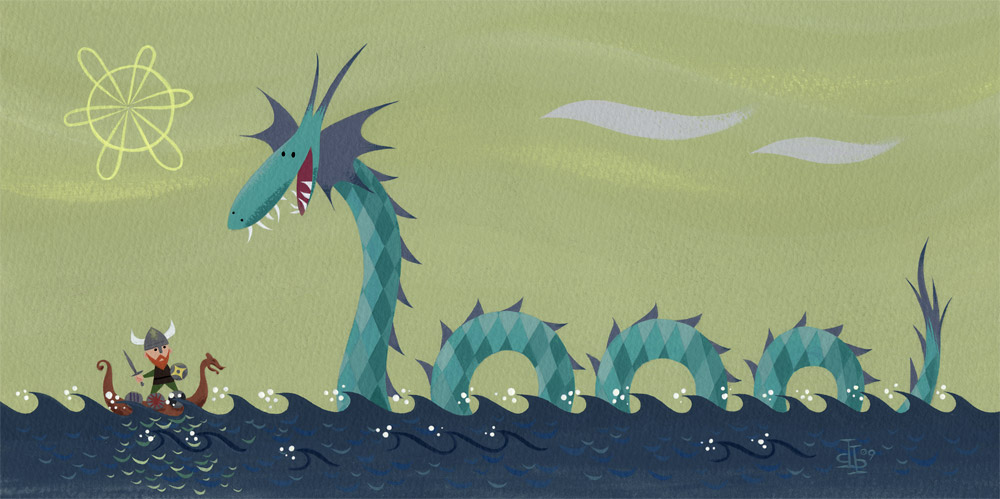
On this date (Aug 22) in 565, the first “documented” sighting of the Loch Ness Monster took place.

Loch Ness is located in the Scottish Highlands, and it’s other claim to fame is that is has the largest volume of fresh water in all of Great Britain – around 23 miles long, and around 800-825 feet at its deepest.

There are maybe a dozen early references to Nessie in Scottish history, including some Pictish carvings of a strange aquatic creature on standing stones near the loch from around 500.

But the earliest written account is a 7th-century biography, The Life of St. Columba by a monk named Adomnán. According to Adomnán, an Irish monk named St. Columba was visiting the Picts when he came across a chaotic scene near the River Ness. Apparently a man had been swimming, and was killed by a “water beast”.

Demonstrating his advanced leadership skills, St. Columba ordered one of his followers, a poor sap named Luigne moccu Min, to swim across the river. As the story goes, the big scary critter gave chase, but was stymied by St. Columba’s great faith and Dr. Doolittle-ish skills. The pious pastor crossed himself, and said, “Go no further. Do not touch the man. Retreat immediately!” According to Adomnán, the critter halted as if it had been tethered, and fled in terror. And there was great rejoicing.

The jury’s still out on what Nessie actually is – if she’s real at all. Is she some kind of plesiosaur that somehow escaped extinction? Is she a long-necked newt, as some folks have theorized? Is she actually an undocumented new species that some scientists have cleverly named Megophias megophias? Who knows?

I kinda hope they never find out definitively. I like that there are still mysteries all around us. I love the fact that there are so many things out there that we don’t know for certain. It keeps us humble. It forces us to keep learning. We all know folks with frozen, atrophied brains. Brain atrophy comes from too much certainty, and not enough doubt.

So, if you aren’t too convicted about stuff, it’s a sign that your brain is still working… feel free to thank Nessie for doing her part!

On this date (Aug 21),


On this date (Aug 21), in 1959, President Dwight Eisenhower signed the proclamation that made Hawaii the 50th state in the Union.

You’ve heard the phrase, “Third time’s the charm,” right? Well, in this case, apparently it was the fifth time that was the charm. Congress saw its first statehood bill for Hawaii back in 1919. Then in 1935, 1947, and in 1950. Finally, in ’59, it worked.

Of course, it wasn’t Congress that kept it from happening earlier. Most Hawaiians wanted statehood – they wanted the benefits they would attain…most specifically, they wanted full voting rights.

Unfortunately, the desires of the people were overshadowed by ‘the man.’ Plantation owners controlled the islands through a group of corporations called The Big Five. This oligarchy had a lot to gain by keeping Hawaii as an annexed territory. Eliminated tariffs, exclusion from anti-trust and price-fixing laws, and a lack of regulations regarding foreign labor – all of these were advantages to the corporations. If Hawaii became a state, they’d be forced to actually obey US laws – which wasn’t good for crooked business.

Unfortunately for the oligarchy, demographics eventually defeated them. By the mid-50s, most of the native labor force had been born after Hawaii had become a US territory… and most of the foreign labor force had come from Puerto Rico – also a US territory. People born in a US territory were legal US citizens. Finally, the Hawaii Republican Party, who had strongly supported the plantation owners and Big Five, were voted out of office. The Democratic Party of Hawaii began to push for statehood. When the referendum asked Hawaiian residents to vote, 94% supported immediate admission into the Union. As a result, with Eisenhower’s signature, our 50th state was finally adopted.

And I’m happy about it. I should be happy because of the politics involved – the little guy’s triumph over the big bully, the populist victory against the forces of oppression.

But really, I’m just happy because this means that Alex O’Loughlin, Scott Caan, Daniel Dae Kim, Grace Park, and Masi Oka get to have jobs working on a show that is one of my favorite escapist avenues… Mahalo, Hawaii Five-0!!

On this date (Aug 20)…

On this date (Aug 20), in 1882, Calvin & Hobbes’ favorite piece of music debuted in the Cathedral of Christ the Saviour in Moscow.

Officially called “The Year 1812, Festival Overture in E flat Major, Op.49”, we normally just call it the 1812 Overture, by Pyotr Ilyich Tchaikovsky.

It’s one of those pieces of music that appeals to the full spectrum of listeners. Artsy-fartsy folks resonate with its passion, the irony of its anachronism, and its powerful, bombastic themes. And those folks who are more, shall we say, Nascar-oriented, dig it because, “Hey, bubba, it’s gots cannons!”

The overture has become a patriotic American staple, providing the soundtrack for countless July 4th fireworks shows across the country – which is fun, since it wasn’t about us at all.

Since the year 1812 is mentioned in the title, many assume that it’s an homage to the American victory over the British in the War of 1812. After all, that war inspired the lyrics of The Star-Spangled Banner, so why not the 1812 Overture as well?

As it turns out, Tchaikovsky was Russian, and while he did make some American appearances (most notably, the inaugural concert of Carnegie Hall in 1891), he wasn’t as interested in American history as you might think.

The overture actually tells the story of how Russia sent Napoleon packing in 1812. You can literally hear the victory as Russia’s old national anthem, God Save the Czar, overpowers the French national anthem, La Marseillaise.

Think of it as the original west coast / east coast hip hop rivalry, but with bigger guns.

And if you are among the Nascar-Americans, don’t worry. This was well before Russia ‘fell into the hands o’ them Commies’, so it’s still safe to listen to it on July 4th.

So, let’s enjoy those cannons. And next time Marvin the Martian asks his timeless question, “Where’s the kaboom?”, we can smile – because we know!