
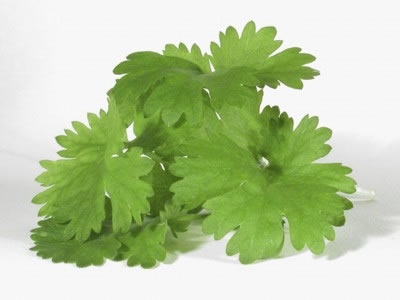
Today’s top news story: Cilantro… Delicious herbal treat? Or silent trendy plague? Is it the global panacea that Art would have you believe? Or is it merely a wannabe parsley trying to be exotic with its pungent, soapy flavor? Let’s take a closer look, shall we? And yes, this means I had too much free time!
Cilantro (Coriandrum sativum) is a member of the Apiaceae (parsley) family. It’s an annual plant that grows anywhere from 2 to 3 feet tall (except in Mikey’s nightmares, when it assumes Little Shop of Horrors status – “Feed me!”). The leaves are currently used as herbs, and the fruits – usually dried and called coriander seeds – are used as a spice and have an entirely different taste.
Although cilantro is often associated with Mexican and Asian cuisines, it’s origin lies in the southern regions of the Mediterranean. In ancient times the leafy, nasty green part was rightly ignored, but coriander seeds have been found in Egyptian tombs from as far back as 3300 BC – as part of the traveling food for their journeys to the next world. It was not only used as food – it also had the medicinal quality of easing indigestion. It’s even mentioned in the Bible – in Exodus 16:31, manna is compared in appearance to coriander seed, and in taste to honey. According to some scholars, one of the first uses of the scary nasty leafy part was in the Passover meal – the horrifying green portion was the bitter herb which symbolized for the Hebrews the abuse and persecution they suffered at the hands of the Pharoahs in Egypt.
Thanks to the expansion-minded Romans, coriander spread to Europe and Asia. The Romans used the awful and frightening cilantro part along with cumin and vinegar as a preservative which they rubbed into meat to mask the taste of rot. In the Han dynasty of China (roughly 200 BC to 200 AD), coriander seeds were used as aphrodisiacs – and their aphrodisiac properties were also touted in the Arabian Nights stories.
Moving forward in history, we find that those famous sugarplums that danced in the heads of the kiddos at Christmas were originally sugar coated coriander seeds – some might say that feeding sugar coated aphrodisiacs to kids right before bed might’ve been cruel… I’ll leave that judgement up to you.
In the modern world, coriander is used commercially to make medications more palatable; it’s also used as a flavoring in gin, pickles, and sausage. Its vile and malevolent leafy counterpart is sometimes used as a component of makeups and perfumes. In addition, the terrifying and malignant green parts of it are used to drive away large musicians – kinda like garlic with vampires. As I surfed the web for my research, I found several anecdotes from people who had sent their food back in restaurants because the astringent, soapy flavor of this evil weed had them thinking that the joint hadn’t properly rinsed their dishes after washing them! I will fully admit that my two hours of research didn’t quite gather enough data for a statistically sound sample, but it appeared that just over half of the world loves cilantro, and just under half of the world hates it. There doesn’t seem to be a lot of middle ground… but we are the underdogs! Which, of course, is perfect for my rebellious neuroses!
As this tirade draws to a close, where are we? What have we learned? Ladies and gentlemen of the jury, I hope that you have come to realize the insidious nature of this demonic green beasty. I hope that you have begun to understand the difference between the healthy and helpful coriander seeds and the environmental catastrophe that is cilantro. Rise up! Rise up and show this soapy leafy nasty herbal blight that you aren’t going to take it anymore – that you aren’t just going to stand by and watch as it turns nice happy dishes into evil wicked tools of Darkness! Join me on a worldwide campaign to rid this planet of this nefarious execrable disease!
Ok, maybe I got a little bit crazy there… If you really want to eat that stuff, go right ahead. After all, I like Cheese Whiz, which only barely qualifies as actual food – so I can’t really talk. I still think cilantro is reminiscent of potpourri, but maybe that’s just me!